About Us

Welcome to Stock Trend Investing. Do you want more financial freedom to have the time and resources to do what makes you happy, to live your purpose and to help others? We want to help you in this.
 
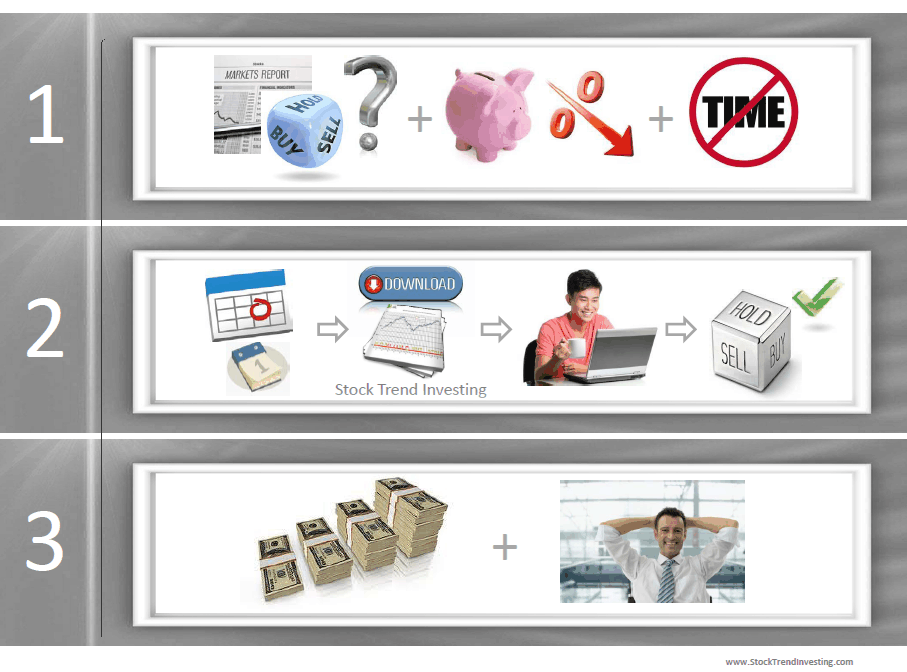
Here you find simple stock market investing strategies that can work for everyone and that enable investors to achieve very good returns when investing their savings. In our Gold Membership service, we explain how we achieve these superior results and peace of mind while spending less than a few hours per month on our investments.
 
We teach the members of our community how to make their savings work for them by capitalizing on stock market trends. Our members generally  have little time to look after their investments since they need or prefer to spend their time on their career and/or their family.
 
Stock Trend Investing was founded by Van Beek to help people like you to start, or continue, their journey to financial independence.
 
On this page you’ll find the three sections listed below. You can navigate to any section by clicking on one of the following links


What is Stock Trend Investing
 
Stock Trend Investing is not a stock broker and is not an investment fund. Our members do not transfer their investments to us.
 
Stock Trend Investing provides valuable free information to the members of its community as well as a Gold Membership service for a very reasonable monthly fee.
 
 
In our monthly Gold Membership updates, we signal what the expected market trends are for the coming months. Based on this information, our gold members can make their buy, sell or hold decisions for their stock market investments. We truly stand for the value we provide to our members and offer therefore always the possibility to try it out risk-free and get your paid membership fees back (no questions asked)  if you cancel the membership within 60 days of its start.
 
 
The expertise of Stock Trend Investing is based on over 15 years of stock market investing experience. Developed initially for personal use, the Stock Trend Investing system is the result of extensive analytical, mathematical and observational analysis and testing of the trends and developments of the last 25 years in initially 12 major stock market indices. The Stock Trend Investing system has been proven for these major market indices in the Americas, Europe and Asia and is applicable around the world.
 
One of the main reasons why this system is so successful is that we do not aim to predict the exact top or bottom of the market. Our objective has been purely to identify every month if we are around a likely top or a bottom in the market. We are focused on trends that last longer than a few months.
 
We do not aim to predict how high or how low the market will go, and we do not predict how much longer the market will move in the current direction until a top or bottom will be set. We are successful because we have just focused on how to identify if we are currently in a period during which the long-term trend of the market is likely to change.
 
 
About Van Beek
 
About Van BeekVan Beek is a senior executive and managing director in international business with a career of over 18 years in telecommunications and online business. A native of the Netherlands, Van Beek and his family have moved across the world due to work commitments to places like Sweden, the Caribbean, India and China.
 
Van Beek holds a Master of Science degree from University of Technology in Eindhoven, The Netherlands.


The Story of Stock Trend Investing
 
Hi there. This is Van Beek. Welcome to this website and to the Stock Trend Investing community. I'd like to tell you my story with investing in the stock market and how this lead to Stock Trend Investing. Let’s go back to the beginning of my stock market experience in the mid-nineties.
 
Like a lot of people, I started investing by buying some local well known stock: I knew the companies but I did not have time to really check their finances. I bought some when I thought they were cheap, or when they showed good growth, and I sold when I got nervous, when I thought they would fall further or when I thought they wouldn't go up anymore. I made money on some, lost on a few, but it was never a lot, it was not consistent, it gave me some stress and it I still had to spend a lot of time on trying to follow the financial news around these companies.
 
Being too busy with work in the year 2000, I saw many people around me making more money in the stock market than I could save from my reasonable to well paid job. That did hurt. The greed slowly crept on me and I decided that I needed to do something. The solution for me was to invest in mutual funds and to spread my investments over different sectors and regions.
 
I followed the advice from my bank, and chose the sectors and regions as suggested by their house-provider of mutual funds. I did not think and know how to compare these funds with other available alternatives (not every mutual fund gives the same results, as you know). I even spread my risk by spreading the buying of the funds over a number of weeks (that was good thinking but not good enough).
 
Losing a lot
 
Thus during March 2000, I invested a major portion of my savings in these funds. Note that I was smart for 2 reasons: I did not invest everything I had and I only invested money that I didn’t need in the years to come. The first months were fantastic. My portfolio value was growing and I didn't have to do anything to make it happen. Great!
 
Then the growth halted and prices went down. I still had profit and I didn't see any reasons to sell my funds. Prices would go up again and I was already so happy with the profit I made that I did not accept a lower profit. And I was in for the long term, thus I just could hang in there. Then I started to make a loss, but I showed perseverance and patience and just hanged in there.
 
The losses became bigger and it was sometimes easier not to look every day or every week any more. And I thought that I'd made the right decisions by spreading by investment over different funds, thus I did not need to worry, right? And the losses became bigger.
 
If I would step out now it would take me many years of low bank account interest to recoup those losses. So I could just as well hang in there. And the losses became bigger. Some of the internet funds lost 80%. Others lost 30%.  It hurt. I did not need the money at that moment, but it hurts also just to see that I was wrong.
 
Getting it back
 
Then things in the stock market started to stabilize and getting better. Initially, I kept to my original fund choices. The sectors were still right and the regions fitted me well. But when I looked at the monthly returns I was getting from these funds and the differences between them, I felt uneasy.
 
I came across the Morningstar website and looked up how my funds are doing compared to the benchmarks. That was a shock. Immediately I got angry on the phone to my bank on how they could have recommended their house-funds that were underperforming the benchmarks by so much. No reply could of course give me my money back. The lesson was simply that I hadn’t done my home work before making the investment decisions.
 
Using Morningstar next, I selected the funds that had shown the best historical performance and that fitted my diversification pattern. A consideration I took into account was which funds I could acquire and own for the lowest fees (this depends on the broker that you use).
 
I decided to stay with my bank (the one who did not give me the best advice before) for broker purposes for the flexibility, convenience and cost advantages it would bring me. I have never regretted that. But I do not rely anymore on their advice on which funds to go for. The funds that I selected myself did well and after a few years I came back into the black compared to my initial capital.
 
Tops and bottoms
 
Overall, the philosophy worked. Buy for the long term and in the end you make money. But a nagging feeling started to creep up. Suppose if I would have sold in the summer or second half of 2000 and started to buy again in 2003, how much more money could I have made?
 
Another observation came up. Everything went down or up at the same time. Some more. Some less. But it went all in the same direction. This fascinated me and to get an understanding of what is happening I started to study the behavior and patterns of the major stock market indices.
 
The ideal is to buy at the bottom and sell at the top. But that is greedy again and who knows where the top and bottom are. Afterwards these are easy to see, but not when you are in the middle of it. But my thinking was as follows: buying just before, or after, the bottom and selling just before, or after, the major tops would also give very, very good returns.
 
So, I started to analyze and look for clues that could help me to define if I would be just before or just beyond a major switch in the direction of the stock market. After a lot of work, detailed analysis and creativity I found the clues and patterns that I was looking for. Thankfully, I don't mind to do this analytical type of work: I like it and it gives me an enormous satisfaction to discover a system that works!
 
Over the years, I have perfected the methodology and tested it on the major stock market indices in the world. In Q4 2007, I sold most of my fund holdings and put my money into a save bank account. Interest rates were not bad during 2008. In Q2 2009, I started to buy again in funds. I sleep well at night and I am happy with the results.
 
Leveraging the Stock Trend Investing system
 
Then I started to think how I could benefit even more from the system I developed. One way is to leverage my system by borrowing money and investing it. However, I see this as very risky. There are always black swans out there: unpredictable events that can have a major (temporary) impact on the markets.
 
When you invest with your own money, you will survive these events. When you invest with borrowed money, these events with temporary disastrous results may cost you all your family’s assets and more.
 
Another way to leverage the Stock Trend Investing system is by sharing it with other people for a very reasonable fee. In this way I do some good to like-minded people and I complement my stock market profits with the gains from selling the services via this website.
 
I have always liked to be able to show other people what is possible and how they can improve their life. And this is definitely a way that can improve your life. Instead of letting your savings rest in a bank account, you can make them work for you. This gives you more income and far less stress than trying ad-hoc investments that you haven't researched fully.
 
Thus, here we are. You do not need to go through the same stressful experiences as me. I can save you a valuable decade, a lot of stress and a lot of money. I invite you to share your experiences and raise your questions on this website. You can comment on our blog posts or contact us with your questions. We will try to answer them all, directly or in new articles on this site.
 
Jump on the bandwagon and join me in making more and easier money from the stock market.
 
Van Beek
 
PS. Here are some of my value and opinion statements related to investing
 
  • There is always some risk in the stock market, but the probability and magnitude have to be kept limited
  • I can accept temporary losses for a few months but for the full year the returns have to be positive and good
  • I do not want to spend a lot of time to investigate the details of the finances of individual companies that I do not have a strong connection with, just to see if I shall invest in them to make money. That is a waste of my time.
  • The market knows best and I do not know more than the market. But I do know that trends are there and that the market continues for a while the direction it is going.
  • Our savings are for my family and are not there to gamble away
  • If others can make money on the stock market, I can do that as well.
  • Safe is better than greed. Too safe does not move you forward.
  • It is no good to make many small gains over time and then to lose it all in a short time. The final result counts more.
  • I want transparency of where my money goes and I want control over my investments. I do not want someone else to take the investment decisions for me.
  • I would really regret it when there is a simple, reliable and ethical way to make extra money and I would not use that opportunity while others who are in a similar position as me are grabbing that opportunity.